Every year, mutual funds pay out the gains they realized by selling holdings. In a U.S. taxable account that payout is taxable to whoever owns the shares when the distribution is made, including someone who bought a few days earlier. This guide explains why that happens, how the IRS treats the distribution, what buying just before the payout actually costs, and what to check before a November or December purchase. It covers U.S. federal tax rules for taxable accounts and is general information, not tax advice.
Why a fund pays out gains you did not earn
Investor.gov's mutual fund overview explains that when a fund sells a security that has risen in price it has a capital gain, and that at the end of the year the fund distributes these capital gains, minus any capital losses, to investors. The gain belongs to the fund's whole history, not to your holding period.
FINRA's mutual funds page spells out the consequence: you might owe capital gains taxes when the fund sells investments for more than it paid, even if the fund is down for the year or you became an investor after the fund bought those investments. The same page notes that in a tax-deferred or tax-free account, such as an IRA, no tax is due on these distributions when you receive them.
How the IRS taxes a capital gain distribution
- Always long-term. IRS Publication 550 says to report capital gain distributions as long-term capital gains, regardless of how long you owned your shares in the mutual fund. Topic 404 says the same.
- Box 2a of Form 1099-DIV. The fund reports the amount as total capital gain distributions in box 2a, separate from ordinary dividends in box 1a, under the Form 1099-DIV instructions.
- Reinvesting does not avoid the tax. Publication 550 says dividends used to buy more shares must still be reported as income. The new shares' basis is the amount reinvested, and each new share's holding period begins the day after it was bought.
- Long-term rates. Long-term gains are taxed at 0%, 15% or 20% depending on taxable income; Topic 409 lists the thresholds for each tax year.
Funds can also keep gains and pay tax on them for you; those undistributed gains are reported on Form 2439 instead of Form 1099-DIV.
Worked example: buying just before the payout
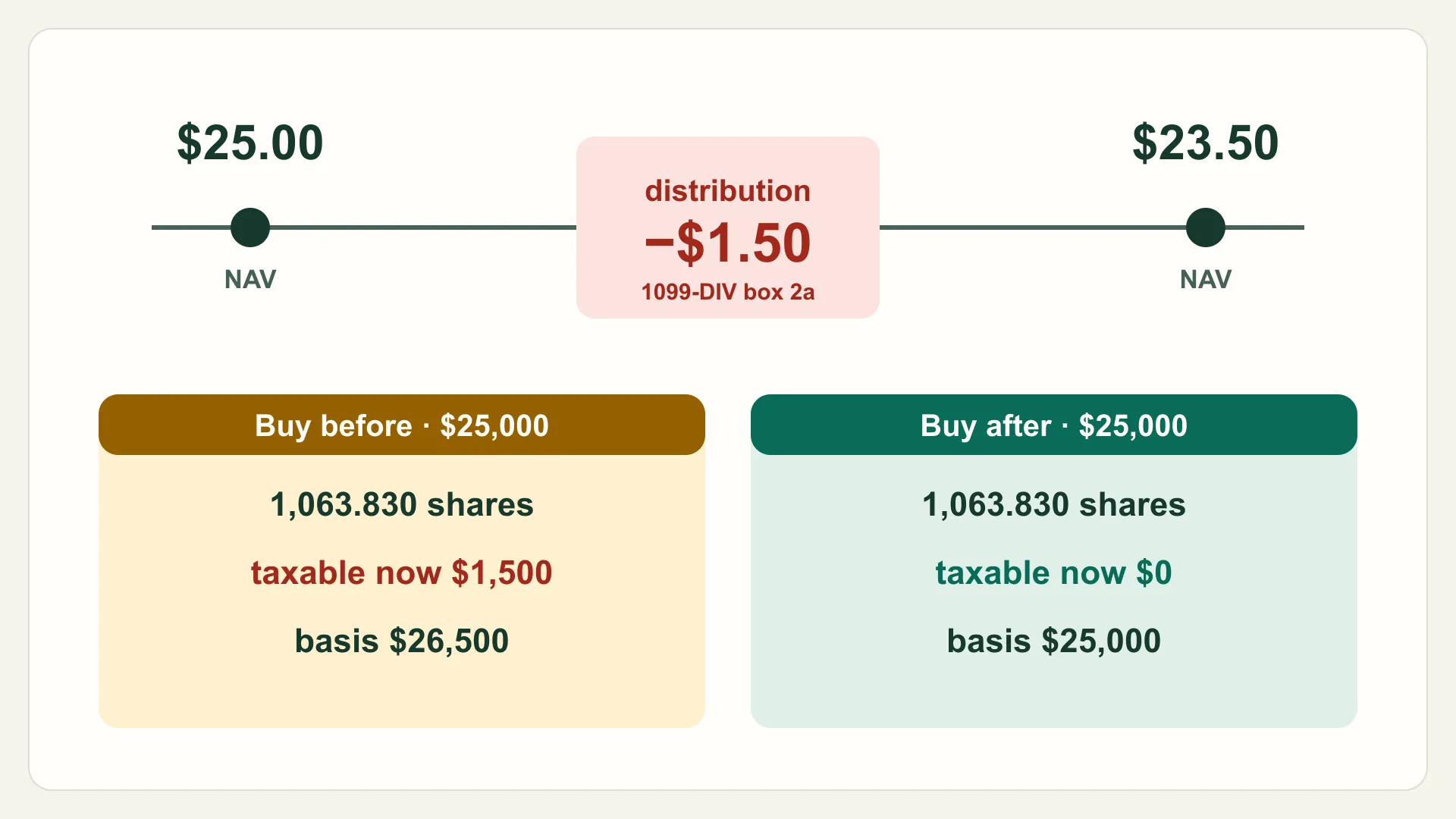
When a fund pays a distribution, the cash leaves the fund's assets, so the value of each share falls by the amount paid, apart from ordinary market movement on the same day. The example below is hypothetical and holds market prices still so the tax effect is visible. Suppose a fund trades at $25.00, will pay a $1.50 per share long-term capital gain distribution in mid-December, and you have $25,000 to invest. The tax line assumes a hypothetical 15% long-term rate.
| Buy before the payout | Buy after the payout | |
|---|---|---|
| Shares bought | 1,000 at $25.00 | 1,063.830 at $23.50 |
| Distribution received | $1,500, reinvested as 63.830 shares at $23.50 | None |
| Shares owned after the payout | 1,063.830 | 1,063.830 |
| Market value | $25,000 | $25,000 |
| Taxable this year | $1,500 long-term gain | $0 |
| Tax at a hypothetical 15% | $225 | $0 |
| Total cost basis | $26,500 | $25,000 |
Both buyers end up with the same shares and the same $25,000. The early buyer has paid $225 of tax this year and holds a basis $1,500 higher. That higher basis reduces a future gain or creates a $1,500 loss if the shares are later sold for $25,000, so the tax is not lost forever; it is paid early, and the offsetting benefit arrives only when you sell and only if you can use it.
The six-month loss rule
Publication 550 adds a rule that stops a quick round trip from turning the payout into a short-term loss. If you hold fund shares for 6 months or less and sell at a loss, the loss is treated as long-term up to the capital gain distributions you received; any remaining loss is short-term. Its own example: a share bought for $20 on April 3, 2025 paid a $2 capital gain distribution on June 17 and was sold for $17.50 on July 15. Of the $2.50 loss, $2 is long-term and $0.50 is short-term.
ETFs and index funds
Investor.gov's ETF bulletin says ETFs can be tax efficient because many buy and sell portfolio securities through in-kind exchanges rather than for cash, so they typically have fewer capital gain distributions than mutual funds. Fewer is not none, and some index mutual funds also distribute little. The index fund vs. ETF vs. mutual fund guide compares the structures in more detail.
Turn the page into action
Before you buy a fund in November or December
- Confirm the account is taxable; in an IRA or 401(k) the payout is not taxed when received.
- Look up the fund company's announced or estimated capital gains distribution and its record and payable dates.
- Compare the expected payout per share with the share price to see how much of your purchase would come back as taxable income.
- If the payout is large and you are not in a hurry, consider buying after the distribution, or a fund with lower expected distributions.
- If you are replacing a fund sold for a tax loss, check the replacement fund's distribution too.
- Keep the year-end statement and Form 1099-DIV, and record the basis of any reinvested shares.
Coordinate with other year-end moves
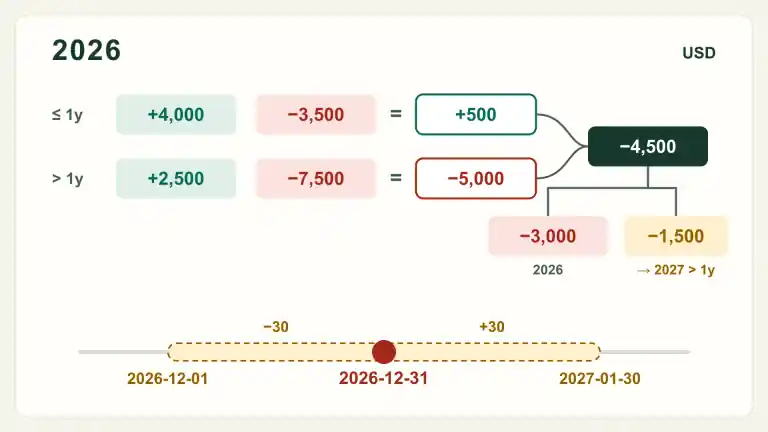
If you sell a fund at a loss in December, the replacement you buy may be about to pay its own distribution; check it before you buy, and keep the 30-day window of the wash-sale rule across accounts in mind. The tax-loss harvesting worksheet covers netting and deadlines, and the FIFO vs. specific identification guide explains how to pick which lots to sell when reinvested shares have different bases.
This guide applies to U.S. federal tax on taxable accounts. Puerto Rico residents, people in Japan and other non-U.S. taxpayers face different rules for fund income.
Evidence to action
Methods and evidence
Structured datasources.jsonformulas.jsonsystems.json
Evidence
Sources
- Mutual Funds
investor-gov-mutual-fundsU.S. Securities and Exchange Commission (Investor.gov)AccessedNovember 11, 2026
- Mutual Funds
finra-mutual-fundsFinancial Industry Regulatory AuthorityAccessedNovember 11, 2026
- Publication 550 (2025), Investment Income and Expenses
irs-pub-550Internal Revenue ServiceAccessedNovember 11, 2026
- Topic no. 404, Dividends and other corporate distributions
irs-topic-404Internal Revenue ServiceAccessedNovember 11, 2026
- Instructions for Form 1099-DIV (01/2024)
irs-form-1099-div-instructionsInternal Revenue ServiceAccessedNovember 11, 2026
- Topic no. 409, Capital gains and losses
irs-topic-409Internal Revenue ServiceAccessedNovember 11, 2026
- Updated Investor Bulletin: Exchange-Traded Funds (ETFs)
investor-gov-etf-bulletinU.S. Securities and Exchange Commission (Investor.gov)PublishedFebruary 23, 2023AccessedNovember 11, 2026
Common questions
Frequently asked questions
Should I buy a mutual fund before or after its capital gains distribution?
In a taxable account, buying just before the payout means you receive part of your purchase back as a taxable distribution. Buying after it avoids that tax for this year. In an IRA or other tax-deferred account, the timing does not create a tax bill when the distribution is paid.
Are capital gain distributions short-term or long-term?
Long-term. IRS Publication 550 says to report capital gain distributions as long-term capital gains regardless of how long you owned the mutual fund shares. They appear in box 2a of Form 1099-DIV.
Do I owe tax on capital gain distributions that are reinvested?
Yes. The IRS treats reinvested distributions as income in the year paid. The new shares get a cost basis equal to the amount reinvested, and their holding period begins the day after they are bought.
Do ETFs pay capital gains distributions too?
They can, but Investor.gov notes that ETFs typically have fewer capital gain distributions than mutual funds because many buy and sell portfolio securities through in-kind exchanges. Check each fund; lower is not the same as zero.