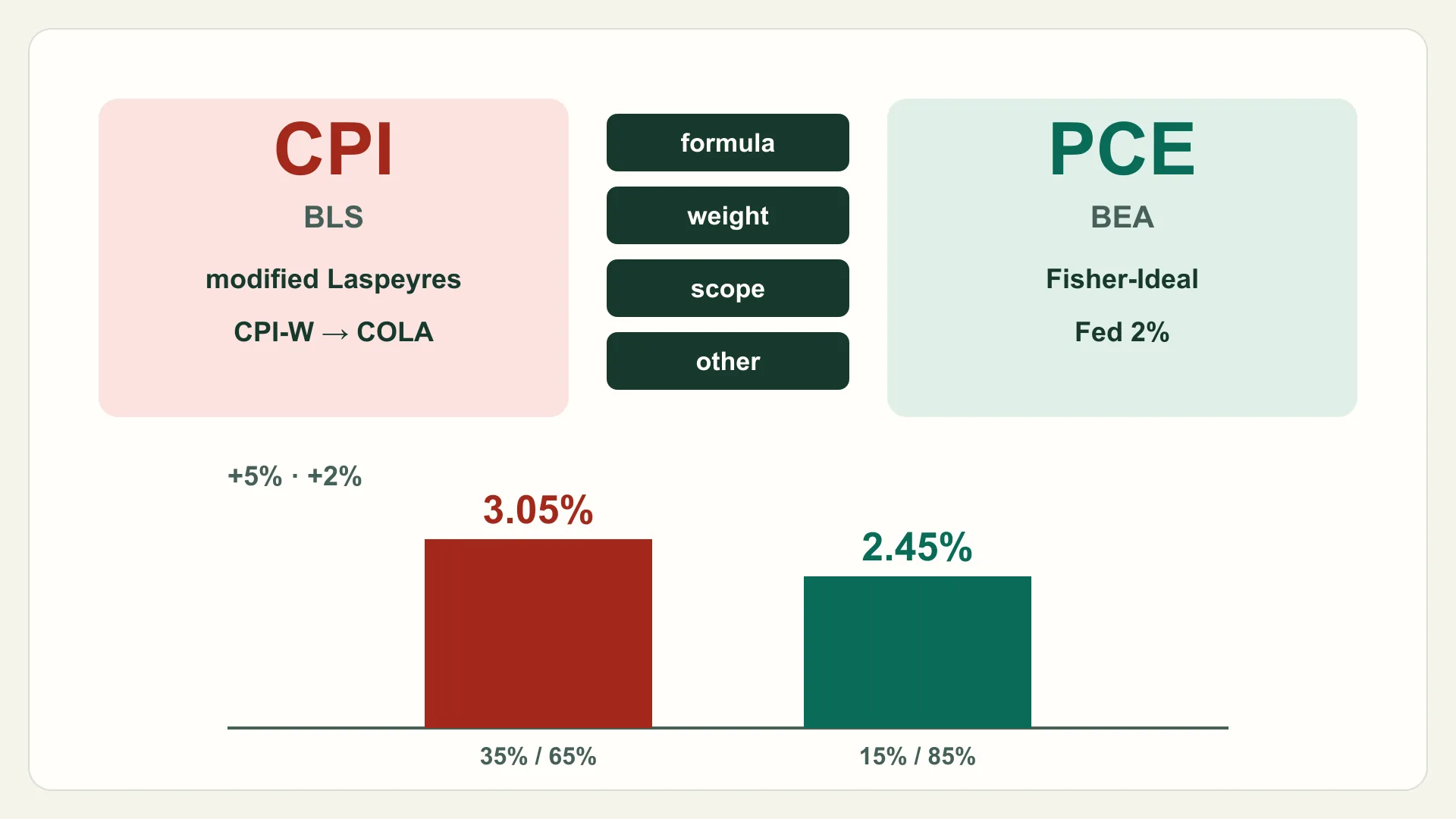
Two U.S. inflation numbers dominate the news. The Consumer Price Index (CPI) is published by the Bureau of Labor Statistics (BLS). The Personal Consumption Expenditures (PCE) price index is published by the Bureau of Economic Analysis (BEA). They often differ by several tenths of a percentage point in the same month. Neither is wrong: they measure different things. This guide sets out the differences, shows how weights alone can move a reading, and matches each index to the question it answers. For a step-by-step walkthrough of a single monthly release, see the guide to reading inflation data.
CPI and PCE side by side
| Feature | CPI | PCE price index |
|---|---|---|
| Publisher | Bureau of Labor Statistics | Bureau of Economic Analysis, in the monthly Personal Income and Outlays report |
| Whose spending | Out-of-pocket spending by households. CPI-U covers over 90% of the population (urban households); CPI-W covers wage-earner and clerical households, about 30% | Spending by and on behalf of households and the nonprofit institutions serving them |
| Formula | Modified Laspeyres | Fisher-Ideal (chain-type) |
| Main official uses | Adjusting payments to consumers, and the Social Security COLA (CPI-W) | The Federal Reserve's 2% longer-run inflation goal |
The population details come from the BLS CPI FAQ, and the scope and formula from BEA's comparison of the two indexes. BLS adds that the "best" inflation measure depends on the intended use, and that the CPI is generally best for adjusting payments to consumers.
The four effects that separate them
BEA publishes a reconciliation of the two indexes (NIPA Table 9.1U) and groups the gap into four parts:
- Formula effect. The indexes use different formulas: Fisher-Ideal for PCE and a modified Laspeyres formula for the CPI.
- Weight effect. The same category can count for more in one index than the other, so identical price changes move the two indexes by different amounts.
- Scope effect. PCE counts spending by and on behalf of the personal sector; the CPI counts out-of-pocket spending by households. The net scope effect adjusts for CPI items outside PCE's scope minus PCE items outside the CPI's.
- Other effects. Seasonal adjustment, price differences and residuals.
BEA's own worked example covers the third quarter of 2006, when the CPI rose 3.7% and PCE 3.0% at annual rates. The largest contribution was the weight effect (0.84 percentage point), mainly owner-occupied housing and gasoline. The scope effect pulled the other way (−0.50 point).
How weights alone change a reading (hypothetical)
To see the weight effect in isolation, take an invented two-category basket where shelter prices rise 5% and everything else rises 2%. The weights below are illustrative, not official.
| Basket | Shelter weight | Other weight | Calculation | Inflation |
|---|---|---|---|---|
| Shelter-heavy (CPI-like) | 35% | 65% | 0.35 × 5% + 0.65 × 2% | 3.05% |
| Shelter-light (PCE-like) | 15% | 85% | 0.15 × 5% + 0.85 × 2% | 2.45% |
Prices did exactly the same thing in both rows. The 0.6-point gap comes only from how much each basket counts shelter. That is why a gap between CPI and PCE is not a sign that either index is unreliable.
Which index answers which question
- Federal Reserve policy and interest rates. The Federal Reserve says the FOMC judges 2% inflation over the longer run, as measured by the annual change in the PCE price index, to be most consistent with its mandate. Read rate decisions against PCE. The Fed rate-change guide shows how a decision reaches household loans and savings.
- Social Security. BLS explains that the COLA is the percent increase in the third-quarter average CPI-W over the previous peak third-quarter average.
- Contracts and escalation clauses. Use the exact index the contract names. BLS notes the choice of index for escalation is up to the user.
- Your own budget. Neither index is your cost of living. Weight your own spending categories, as in the raise-vs-inflation guide, and use CPI or PCE only as the economy-wide backdrop.
Turn the page into action
Before quoting an inflation number
- Name the index: CPI-U, CPI-W, chained CPI or PCE.
- Check headline vs. core (excluding food and energy).
- Check the period: month over month or year over year.
- Check seasonal adjustment.
- Match the index to the question: benefits, Fed policy, a contract or your budget.
- Never subtract one index's rate from the other's and call it a measurement error.
Boundaries
This guide describes U.S. federal statistics and uses official explanations from BLS, BEA and the Federal Reserve. The weight table is hypothetical and does not reproduce either index's published weights. Puerto Rico and other territories, other countries' consumer price indexes and private inflation gauges follow different methods. Nothing here forecasts inflation or recommends an investment.
Evidence to action
Methods and evidence
Methods used
- Personal spending inflation
personal inflation = weighted sum of category price relatives − 1
Related data series
- U.S. Consumer Price IndexCataloged; automatic updating is not active yet.
- U.S. PCE price indexCataloged; automatic updating is not active yet.
Next actions
Structured datasources.jsonformulas.jsonsystems.json
Evidence
Sources
- Consumer Price Index Frequently Asked Questions
bls-cpi-faqU.S. Bureau of Labor StatisticsAccessedNovember 2, 2026
- What accounts for the differences in the PCE price index and the Consumer Price Index?
bea-pce-cpi-differencesU.S. Bureau of Economic AnalysisAccessedNovember 2, 2026
- Personal Consumption Expenditures Price Index
bea-pce-price-indexU.S. Bureau of Economic AnalysisAccessedNovember 2, 2026
- Why does the Federal Reserve aim for inflation of 2 percent over the longer run?
fed-2-percent-goal-faqBoard of Governors of the Federal Reserve SystemAccessedNovember 2, 2026
Common questions
Frequently asked questions
Which inflation measure does the Federal Reserve target?
The Fed says the FOMC judges that inflation of 2 percent over the longer run, as measured by the annual change in the price index for personal consumption expenditures (PCE), is most consistent with its mandate.
Which index sets the Social Security cost-of-living adjustment?
BLS explains that the COLA is the percent increase in the third-quarter average of the CPI-W, a CPI for urban wage earners and clerical workers, over the previous peak third-quarter average.
Why do CPI and PCE inflation differ?
BEA groups the gap into formula, weight, scope and other effects. In BEA's own example, the largest contribution came from weights, mainly owner-occupied housing and gasoline, which carried more weight in the CPI in that example.
Which number should I use for my own budget?
Neither measures your personal costs exactly. Use your own spending categories to estimate personal inflation, and use the CPI or PCE only to understand the economy-wide trend.