An extra auto-loan payment is useful only if you understand what the servicer did with it. A changed due date, a lower “amount due,” and a smaller principal balance answer different questions. Save the statement before the payment, the transaction confirmation, and the next statement so you can reconcile the actual result.
This guide addresses U.S. consumer auto loans. Contracts and state rules differ. It helps you inspect records and prepare questions; it does not change a lender’s instructions or determine your legal rights.
Does an extra car payment go to principal?
Usually only the part left after fees and interest. The CFPB explains that an auto-loan payment is generally applied first to any fees due, such as late fees, then to interest due, including interest accrued since earlier payments, and only then to principal. The CFPB adds that you may be able to ask the lender or servicer to apply more of a payment to principal, so check your loan documents and the payment options first.
In practice: pay the regular amount on time, send the extra as a separate payment marked "principal only" if the servicer offers that option, and confirm the result on the next statement. The steps below show how.
| Plan | Monthly amount | Payments to payoff | Total interest |
|---|---|---|---|
| Scheduled payments only | 397.91 | 60 | 3,874.92 |
| Extra $100 to principal each month | 497.91 | 47 | 2,952.94 |
The extra $100 a month saves about $922 of interest and 13 payments, but only if every extra dollar reaches principal and payments post on schedule. Daily interest, posting dates, fees and precomputed-interest contracts change the result. The loan payment guide shows the underlying arithmetic.
Identify the interest method first
The CFPB distinguishes simple-interest and precomputed-interest auto loans. With simple interest, interest is calculated from the outstanding balance on a daily or monthly basis. Paying principal earlier can reduce later interest, although timing and the contract still matter. With precomputed interest, the finance charge is calculated in advance and extra-payment results can differ.
Find the method in the contract or ask the servicer to identify it in writing. Also check for a prepayment penalty, transaction fee, late fee, or other amount that might be paid before principal. Do not infer the method from an online payment button.
The loan-repayment calculator models amortizing loans and extra principal, but it cannot reproduce every lender’s day-count method, posting time, fee rule, or precomputed-interest contract.
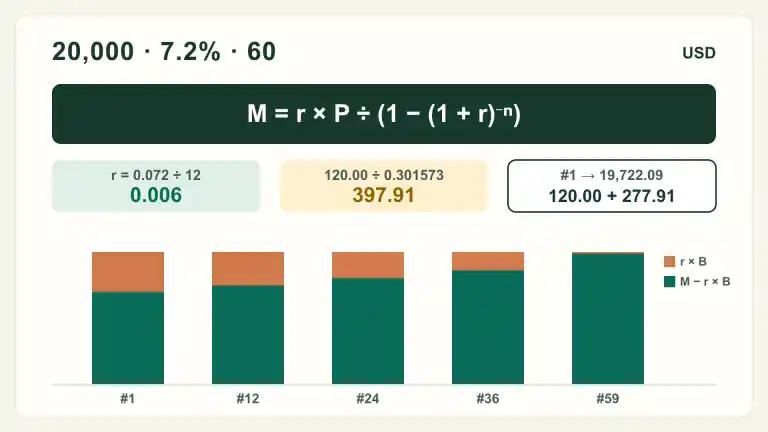
To check the scheduled payment and each month's interest and principal split yourself, follow the step-by-step loan payment calculation. Its hypothetical $20,000 example shows the amortization formula, the first rows of the schedule and the balance after any payment.
Record five numbers before paying extra
From the latest statement or current transaction history, record:
- Principal balance.
- Accrued but unpaid interest.
- Unpaid fees.
- Required payment and due date.
- Date through which interest has been calculated.
Then save the amount and timestamp of the extra payment and any instruction you selected, such as “principal only.” A screenshot is useful, but keep the official confirmation or downloaded record when available.
If a regular payment is due, clarify whether an extra transaction replaces it. Do not assume that an additional payment removes the obligation to make the scheduled payment.
Reconcile the transaction, not just the next due date
The CFPB explains that auto-loan payments generally cover due fees, then accrued interest, with the remainder reducing principal. It recommends reviewing the statement and loan documents and contacting the servicer about how the payment was applied.
Use this reconciliation:
Principal reduction = payment − fees paid − interest paid − any other documented allocation.
If a $1,000 payment covers $20 of fees and $80 of accrued interest, a $900 principal reduction would reconcile the transaction. Compare that result with the principal balance after accounting for any other payments, adjustments, or new transactions in the same period.
Paid-ahead status and principal reduction can occur together. A servicer may move the due date because enough money was received while also reducing the balance. Conversely, a later due date by itself does not prove how much principal changed. The balances and transaction detail provide the evidence.
Check your payment allocation
U.S. auto-loan record reconciliation in USD. This does not calculate accrued interest, interpret a contract, or provide a payoff quote.
Private worksheet. No account numbers or personal identifiers. Nothing entered is sent to Nortune. Save only on a device you trust; downloaded files are not encrypted.
Interactive controls need JavaScript. The article instructions remain available; you can make the same record on paper.
USD only. Enter up to 2 decimal places, using a dot or comma without thousands separators. Blank means unknown; enter 0 only when you have confirmed none.
Reconciliation results
Explained principal = payment − interest − fees − other allocations. Expected ending principal = starting principal − explained principal − other principal reductions + other principal increases.
A zero difference reconciles the entries, not the contract or complete account history. A nonzero difference is a question to investigate, not proof of lender or broker error.
Compare successive statements carefully
Read the statement immediately before the extra payment and the first statement that contains it. Check the beginning principal, each posted transaction, principal paid, interest paid, fees, ending principal, next due date, and any unpaid amount.
Posting near a statement cutoff can put the transaction on the following statement. A returned payment or reversal can also change the result. If the displayed balance does not reconcile, ask for a transaction-level allocation and the date the payment was effective for interest calculation.
Do not rely only on an amortization schedule prepared at origination. It shows the expected path under its assumptions, not necessarily the timing and allocation of the transactions that actually posted.
Ask precise questions when the numbers differ
Contact the servicer through an official channel and keep the response. Useful questions are:
- What interest method does this contract use?
- How much of transaction X went to fees, interest, and principal?
- What effective date was used to calculate interest?
- Did the payment create paid-ahead status, and did it also reduce principal?
- What instruction is required for future extra-principal payments?
- Is another scheduled payment still due?
- Is there any prepayment charge or limit?
If the answer is verbal, write down the date, representative, and explanation. Ask whether a written payment history or allocation breakdown is available. If you believe the servicer did not follow the contract or applicable law, use the company’s dispute process and consider qualified local consumer assistance.
Update the payoff plan with verified balances
After the transaction is settled, enter the verified principal balance, rate, remaining term, and extra-payment plan into the calculator. Compare the projected payoff date and interest with a no-extra-payment case. Keep required payments, cash reserves, and debt priorities in view before committing all available cash.
Reconcile the next statement again. A projection is a decision aid; the lender’s records and contract determine the actual balance. Repeat the check whenever the amount, timing, or payment instruction changes.
Evidence to action
Methods and evidence
Methods used
- Amortizing payment
payment = periodicRate × principal ÷ (1 − (1 + periodicRate)^−periods)
Next actions
Structured datasources.jsonformulas.jsonsystems.json
Evidence
Sources
- Paying interest or principal on an auto loan
cfpb-auto-principal-2024Consumer Financial Protection BureauPublishedJanuary 30, 2024AccessedSeptember 2, 2026
- Simple and precomputed interest on auto loans
cfpb-auto-interest-methods-2024Consumer Financial Protection BureauPublishedJanuary 30, 2024AccessedSeptember 2, 2026
Common questions
Frequently asked questions
Does an extra car payment go to principal?
The CFPB explains that auto-loan payments generally go first to fees due, then to interest due, including accrued interest, and then to principal. Only the amount left after those reaches principal unless your lender lets you designate it otherwise.
How do I make sure an extra payment goes to principal?
Check your loan documents, then ask the servicer whether you can mark a separate payment as principal only. Keep the confirmation and compare the principal balance on the next statement.
Does a later due date prove my extra payment missed principal?
No. A due-date change describes scheduling, not the entire transaction allocation. Use the principal balances, accrued interest, fees, and transaction detail on successive statements to see what changed.
Can a car lender apply an extra payment to interest first?
Payments commonly cover due fees and accrued interest before the remainder reduces principal, but the contract and applicable rules control. Check the loan documents and obtain an allocation explanation from the servicer.
Will every extra payment save the same amount of interest?
No. Savings depend on the interest method, timing, remaining balance, fees, and contract terms. Precomputed-interest loans can respond differently from simple-interest loans, so verify the method before relying on a projection.