An employee stock purchase plan (ESPP) lets you buy employer shares through payroll, often at a discount. When you sell, the timing decides how the profit is taxed. If you sell before the qualifying date (a disqualifying disposition), the discount you received at purchase is taxed as wages. If you wait (a qualifying disposition), the part taxed as wages is usually smaller and the rest is long-term capital gain.
This guide applies the rules in IRS Publication 525 for U.S. section 423 plans to one hypothetical purchase in U.S. dollars. Plans that are not section 423 plans, non-U.S. plans and state taxes work differently. This is general education, not tax advice.
Step 1: read your Form 3922
For a discounted purchase, your employer sends Form 3922 after the year of the transfer. The Instructions for Forms 3921 and 3922 list the boxes you need:
| Box | What it shows | Example |
|---|---|---|
| 1 | Date option granted (start of the offering period) | January 2, 2025 |
| 2 | Date option exercised (purchase date) | June 30, 2025 |
| 3 | Fair market value per share on grant date | 40.00 |
| 4 | Fair market value per share on exercise date | 50.00 |
| 5 | Exercise price paid per share | 34.00 (85% of the lower value) |
| 6 | Number of shares transferred | 100 |
| 7 | Date legal title transferred | June 30, 2025 |
| 8 | Exercise price per share as if exercised on the grant date | 34.00 |
Step 2: find the qualifying date
Publication 525 says you meet the holding-period requirement if you don't sell until the end of the later of two periods: 1 year after the shares were transferred to you and 2 years after the option was granted.
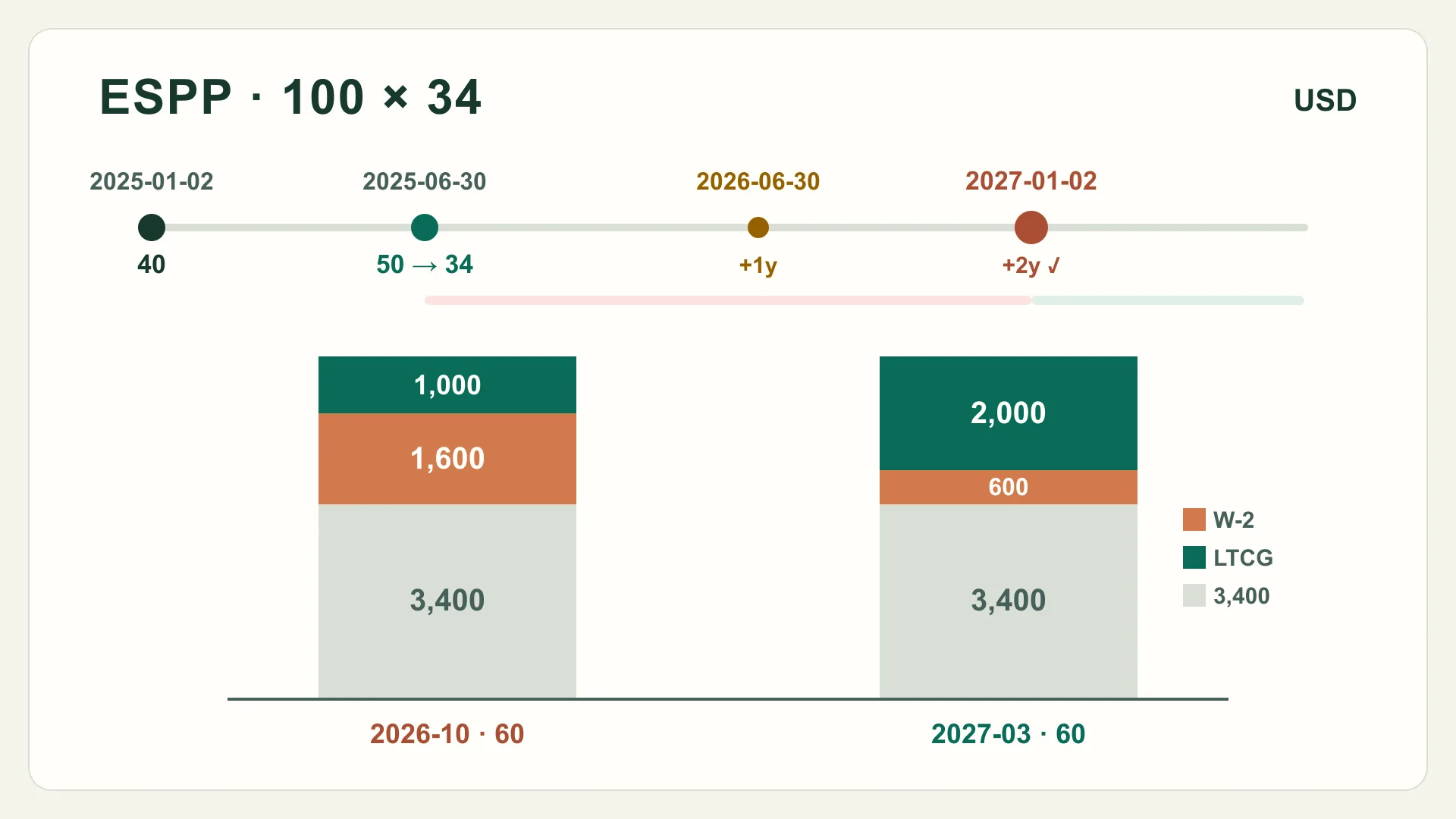
In the example, 1 year after the June 30, 2025 transfer is June 30, 2026, and 2 years after the January 2, 2025 grant is January 2, 2027. The later date controls, so a sale after January 2, 2027 is qualifying. Any earlier sale is disqualifying, even one more than a year after purchase.
A disqualifying sale can still produce a long-term capital gain or loss. The capital holding period starts the day after the purchase date, so the sale must come more than one year after June 30, 2025.
Disqualifying disposition: the whole purchase discount is wages
If you don't meet the holding-period requirement, Publication 525 makes your ordinary income the fair market value on the purchase date minus the price you paid. That amount is not limited to your gain from the sale. You add it to your basis, and the difference between the increased basis and the sale price is a capital gain or loss.
Qualifying disposition: wages are capped
If you meet the requirement and the option price was a discount (at least 85% of the share's value), your ordinary income is the lesser of two amounts:
- the grant-date value minus the option price. If the price wasn't fixed at grant, as in a lookback plan, it is figured as if the option had been exercised on the grant date (box 3 − box 8); or
- the sale price minus the price you paid.
Any further gain is capital gain. If you sell at a loss, Publication 525 says it is a capital loss and there is no ordinary income.
Four hypothetical sales of the same 100 shares
| Sale | Type | Proceeds | Ordinary income (wages) | Adjusted basis | Capital gain or loss |
|---|---|---|---|---|---|
| Oct 1, 2026 at $60 | Disqualifying | 6,000 | 1,600 = (50 − 34) × 100 | 5,000 | +1,000 long-term |
| Mar 1, 2027 at $60 | Qualifying | 6,000 | 600 = lesser of (40 − 34) × 100 and (60 − 34) × 100 | 4,000 | +2,000 long-term |
| Oct 1, 2026 at $30 | Disqualifying | 3,000 | 1,600 | 5,000 | −2,000 long-term |
| Mar 1, 2027 at $30 | Qualifying | 3,000 | 0 (sold at a loss) | 3,400 | −400 long-term |
In every row, wages plus the capital result equals proceeds minus the $3,400 paid, so nothing is counted twice. Waiting moved $1,000 from wages into capital gain at $60. At $30, the disqualifying sale still created $1,600 of wages next to a $2,000 capital loss, and capital losses are limited when they exceed gains (see the tax-loss harvesting worksheet). What this is worth depends on your own rates and on the risk of holding the stock longer, which this example does not estimate.
Step 3: report it without paying twice
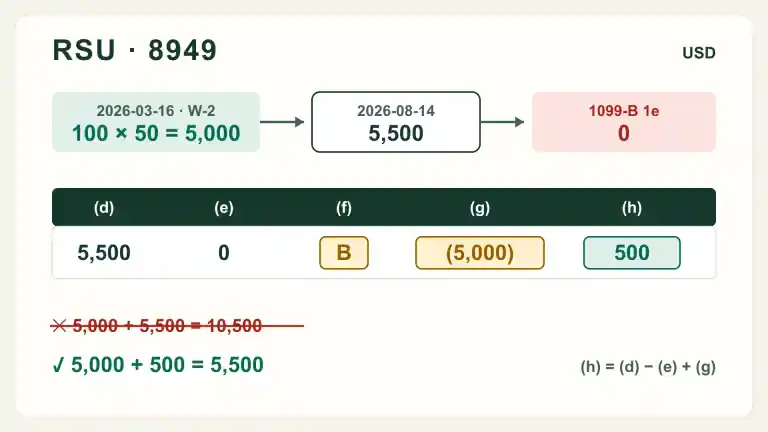
Publication 525 says your employer or former employer should report the ordinary income as wages in box 1 of Form W-2. Check that it is there for the year of sale. If it isn't, you still report it. For options granted on or after January 1, 2014, the basis on Form 1099-B won't include that income. Enter the reported basis, code B and a negative adjustment on Form 8949, following the Form 8949 instructions. The step-by-step code B guide shows the columns with an RSU example, and the same method applies here.
Turn the page into action
Before selling ESPP shares
- Find Form 3922 for each purchase: boxes 1, 3, 4, 5, 6, 7 and 8.
- Compute the qualifying date: the later of box 1 + 2 years and box 7 + 1 year.
- Estimate wages and capital gain for selling now and after the qualifying date.
- Check how concentrated your employer stock already is.
- After selling, confirm the wage amount on your W-2 or report it yourself.
- Adjust basis on Form 8949 with code B and keep Form 3922 with your records.
Tax is not the only question
Holding for a qualifying disposition means keeping employer stock for up to two years. Your paycheck already depends on the same company. A fall in the share price can outweigh the tax difference, as the $30 rows show. The guide to reducing income concentration risk and the RSU and ESPP basis reconciliation help you weigh the position as a whole.
Boundaries
All figures are hypothetical and in U.S. dollars, and the rules summarized come from the current IRS Publication 525 and form instructions linked above. Check the versions for the year you file. Non-section 423 plans, incentive stock options, alternative minimum tax, death or divorce transfers, sales to meet conflict-of-interest rules, nonresident or cross-border work, Puerto Rico residence and state taxes can change the result. This page is not individual tax or investment advice.
Evidence to action
Methods and evidence
Methods used
- ESPP ordinary income on sale
disqualifying: (FMV at purchase − price paid) × shares; qualifying: min((FMV at grant − option price as if exercised at grant) × shares, max(0, proceeds − price paid × shares)) - Equity-compensation basis
basis = amount paid + compensation income included, subject to the plan and transaction rules
Next actions
Structured datasources.jsonformulas.jsonsystems.json
Evidence
Sources
- Publication 525: Taxable and Nontaxable Income
irs-pub-525Internal Revenue ServiceAccessedOctober 30, 2026
- Instructions for Forms 3921 and 3922
irs-form-3922-instructionsInternal Revenue ServiceAccessedOctober 30, 2026
- Instructions for Form 8949
irs-form-8949-instructionsInternal Revenue ServiceAccessedOctober 30, 2026
Common questions
Frequently asked questions
When does an ESPP sale become a qualifying disposition?
Under IRS Publication 525, you meet the holding-period requirement if you don't sell until the later of 1 year after the shares were transferred to you and 2 years after the option was granted. The grant and transfer dates are in boxes 1 and 7 of Form 3922.
How much ordinary income is there in a disqualifying disposition?
The fair market value on the purchase (exercise) date minus the price you paid. It is not limited to your gain, so it applies even if you sell at a loss. You add it to your basis, and the rest is capital gain or loss.
How much ordinary income is there in a qualifying disposition?
For a discounted plan, the lesser of the grant-date value minus the option price figured as if exercised on the grant date, or the sale price minus the price you paid. If you sell at a loss, there is no ordinary income.
Why does my Form 1099-B basis for ESPP shares look too low?
For options granted after 2013, the 1099-B basis won't include the ordinary income you report as wages. Add it yourself on Form 8949 with code B, or the same income can be taxed twice.