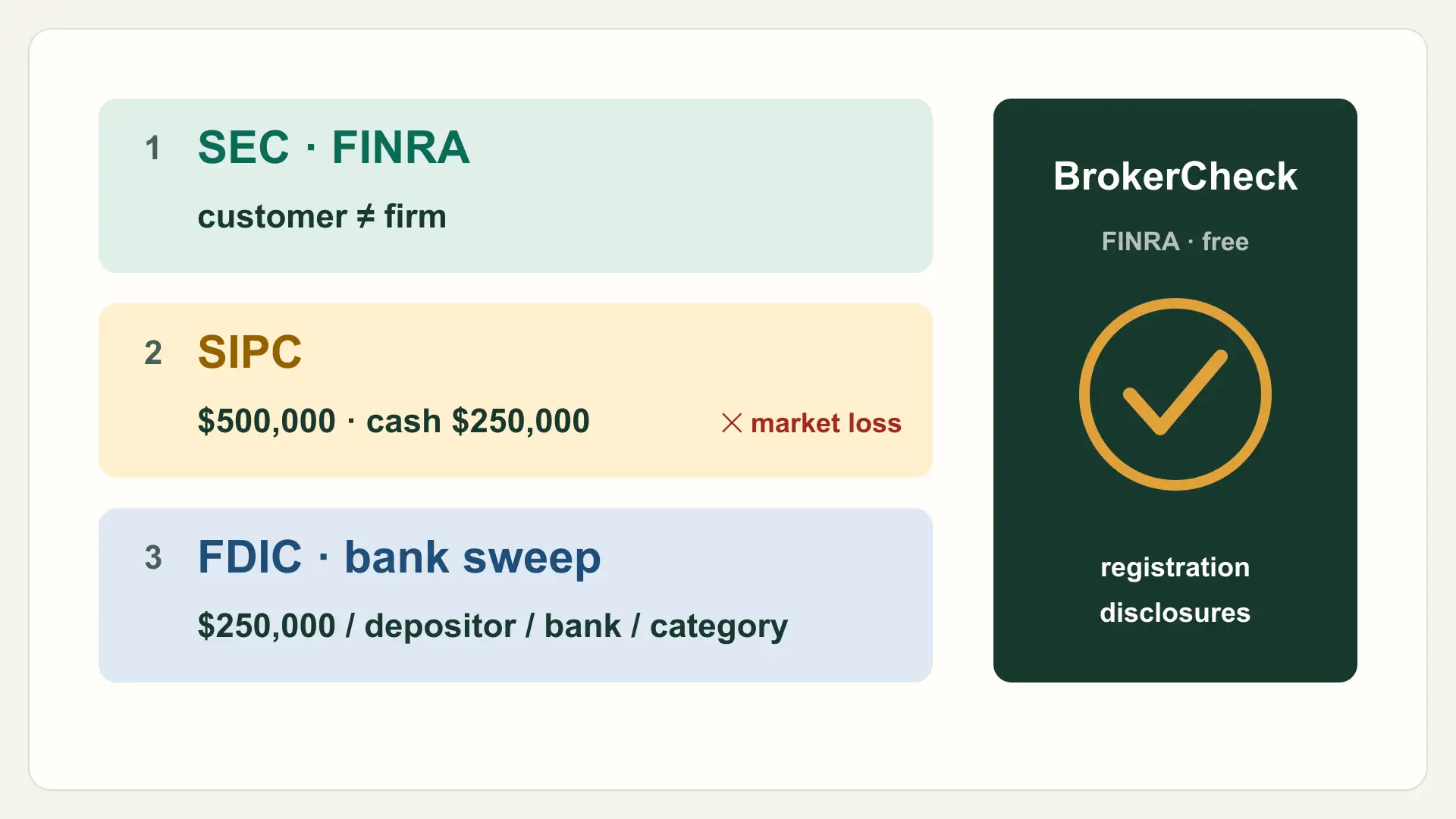
"Is my brokerage account safe?" is really three separate questions. Is your property kept apart from the firm's own money? What happens if the firm fails? And is the firm genuine and registered at all? Investment risk, the chance that what you own falls in value, is a fourth matter that none of these protections addresses. This guide explains each layer for U.S. brokerage accounts using the regulators' own explanations, then shows how to check a broker in a few minutes.
Layer 1: your property is kept separate from the firm's
The first protection is structural. Investor.gov's SIPC bulletin explains that brokerage firms, under regulation by the SEC and FINRA, must segregate customer property from the firm's business. If a firm fails, customer property should therefore be intact and separate from the failed business. Insurance-style protection matters mainly when something has gone wrong with that separation.
Layer 2: SIPC if a member firm fails
The Securities Investor Protection Corporation protects customer assets when a SIPC-member brokerage firm fails financially. It covers the loss of cash and securities, such as stocks and bonds, held at the failed firm. The limit is $500,000 per customer, which includes a $250,000 limit for cash. SIPC also states that money-market mutual funds, often thought of as cash, are protected as securities.
SIPC is not market insurance. In SIPC's own words, it does not protect against the decline in value of your securities. It also does not cover:
- commodity futures contracts (unless held in a special portfolio-margining account), foreign exchange trades, or cash held in connection with a commodities trade;
- investment contracts, such as limited partnerships, and fixed annuity contracts that are not registered with the SEC;
- any digital or crypto asset that does not qualify as a security.
Layer 3: FDIC for cash swept to a bank
Many brokers move idle cash into deposits at partner banks. Investor.gov notes that because bank-sweep cash is held outside the brokerage firm, SIPC would not protect it if the firm fails. Protection comes from the bank's deposit insurance instead. The FDIC covers $250,000 per depositor, per FDIC-insured bank, for each account ownership category. It covers only deposits. Stocks, bonds, mutual funds, annuities, crypto assets and U.S. Treasury securities are not covered, even when an FDIC-insured bank offers them.
The cash sweep vs. money-market fund guide compares yield, access and these protections in detail.
Map each part of your account to its protection
| Part of the account | Amount | Main protection if something fails | Limit to compare |
|---|---|---|---|
| Stocks, ETFs and mutual funds held at the broker | 400,000 | Segregation; then SIPC if property is missing at a failed member firm | $500,000 per customer, combined with cash |
| Cash held at the broker for buying securities | 100,000 | Segregation; then SIPC | Within the $500,000, at most $250,000 for cash |
| Cash swept to Bank A | 100,000 | FDIC at Bank A (not SIPC) | $250,000 per depositor, per bank, per ownership category |
| Your own savings account at Bank A | 180,000 | FDIC at Bank A | Counts toward the same $250,000 if the ownership category matches |
In this example the brokerage holdings fit inside SIPC's limits. At Bank A, though, the swept cash and the direct savings add up to $280,000 in the same ownership category, so $30,000 would sit above the FDIC standard amount. That is a reason to check which banks your broker sweeps to, not a prediction that any bank or broker will fail. Real coverage depends on account titling, ownership categories and the exact facts, so treat this table as a way to organize questions.
Is the broker legitimate? Check before you fund
Protections assume you are dealing with a real, registered firm. FINRA's BrokerCheck is a free tool for researching brokerage firms, investment adviser firms and individual professionals. It shows current registrations and disclosures such as customer disputes, disciplinary events and certain criminal and financial matters. Some disclosures may involve pending allegations that have not been proven, so read them carefully.
Investor.gov advises always checking that a financial professional is licensed, and notes that unlicensed, unregistered people commit much of the investment fraud in the United States. FINRA's Ask and Check page is direct: if someone says they aren't registered or licensed, say goodbye and don't buy.
For a specific firm, our reviews of E*TRADE, Charles Schwab and Fidelity each include a safety and custody section. The broker comparison guide covers the rest of the choice.
Turn the page into action
Five-minute broker check
- Find the firm's exact legal name on your account agreement or website footer.
- Look it up on FINRA BrokerCheck: confirm registration and read any disclosures.
- Confirm the firm says it is a SIPC member.
- Find out where your idle cash goes: brokerage cash, a bank sweep (which banks) or a money-market fund.
- Add up deposits you hold at each sweep bank, including your own accounts there.
- Walk away from anyone who says they are not registered or licensed.
Boundaries
This guide summarizes U.S. protections as described by SIPC, the FDIC, FINRA and the SEC's Investor.gov. Figures are hypothetical and in U.S. dollars. It does not cover non-U.S. brokers, crypto exchanges that are not SIPC members, insurance products, or protections a firm may buy privately. It is not legal or investment advice. For a real claim or a complex account title, use the official SIPC and FDIC resources and qualified advice.
Evidence to action
Methods and evidence
Structured datasources.jsonformulas.jsonsystems.json
Evidence
Sources
- How SIPC protects customers
sipc-investor-protectionSecurities Investor Protection CorporationAccessedNovember 8, 2026
- Understanding Deposit Insurance
fdic-understanding-deposit-insuranceFederal Deposit Insurance CorporationAccessedNovember 8, 2026
- About BrokerCheck
finra-about-brokercheckFinancial Industry Regulatory AuthorityAccessedNovember 8, 2026
- Investor Bulletin: SIPC Protection Part 1 – SIPC Basics
investor-gov-sipc-bulletin-1U.S. Securities and Exchange Commission (Investor.gov)AccessedNovember 8, 2026
- Investor Bulletin: SIPC Protection Part 2 – Filing a SIPC Claim
investor-gov-sipc-bulletin-2U.S. Securities and Exchange Commission (Investor.gov)AccessedNovember 8, 2026
- Check Out Your Investment Professional
investor-gov-check-professionalU.S. Securities and Exchange Commission (Investor.gov)AccessedNovember 8, 2026
- Ask and Check
finra-ask-and-checkFinancial Industry Regulatory AuthorityAccessedNovember 8, 2026
Common questions
Frequently asked questions
What happens to my investments if my brokerage firm fails?
Brokerage firms must keep customer property separate from the firm's own business, so it should be intact if the firm fails. If property is missing, SIPC protects customers of a failed member firm up to $500,000, including a $250,000 limit for cash.
Does SIPC protect me if my stocks lose value?
No. SIPC says it does not protect against the decline in value of your securities. It covers missing cash and securities when a member firm fails, not market losses.
Is cash in a bank sweep protected by SIPC or the FDIC?
Investor.gov explains that bank-sweep cash is held outside the brokerage firm, so SIPC would not protect it if the firm fails. If the bank is FDIC-insured, FDIC deposit insurance covers $250,000 per depositor, per bank, for each ownership category.
How can I check whether a broker is legitimate?
Look the firm and any individual up on FINRA's free BrokerCheck, which lists registrations and disclosures such as disciplinary events. FINRA's advice is blunt: if they say they aren't registered or licensed, don't buy.