The October 22 release in context
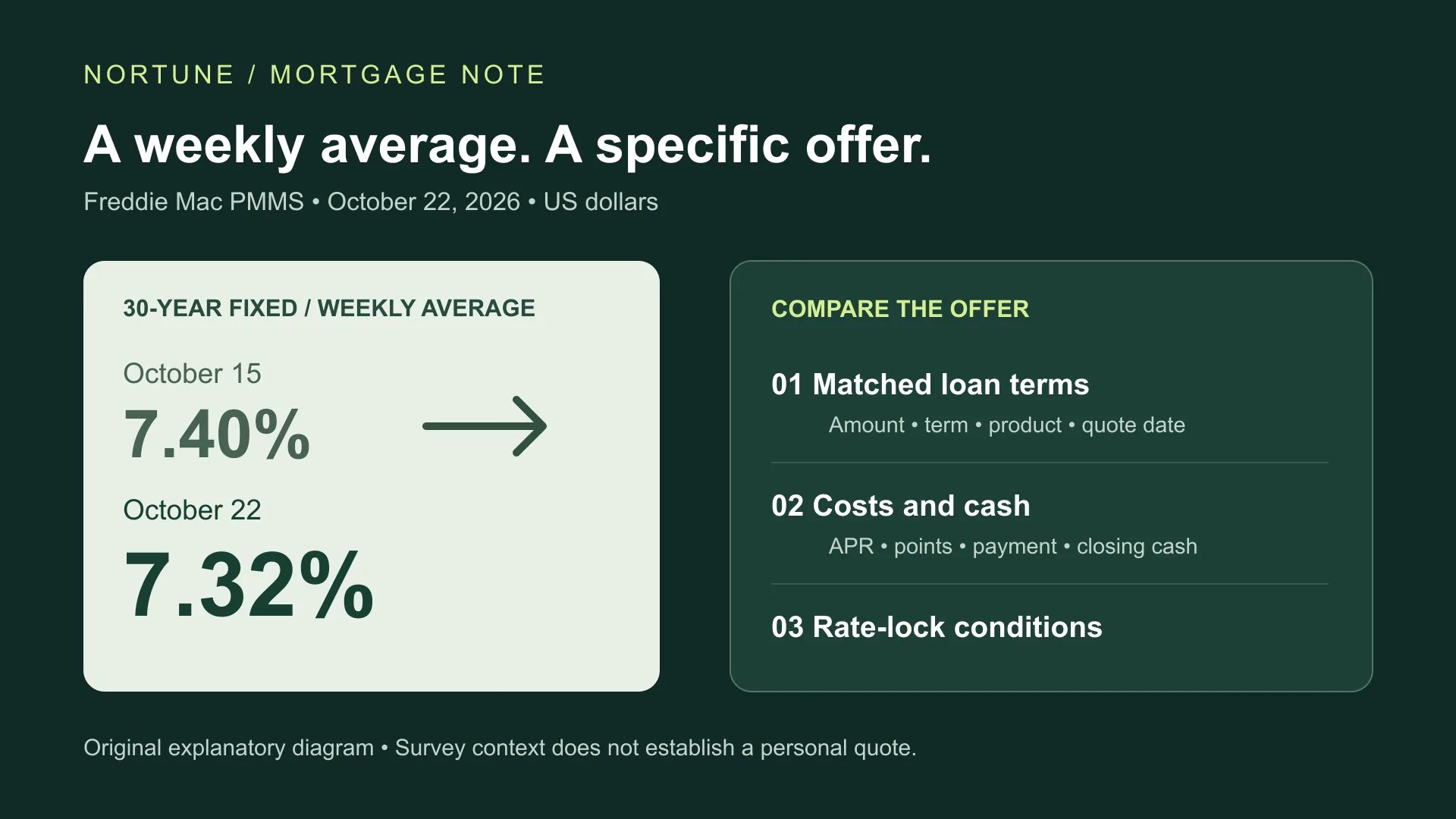
Freddie Mac’s October 22, 2026 mortgage survey reported a 7.32% average for a US 30-year fixed-rate mortgage, compared with 7.40% the previous week. The 15-year average moved from 6.71% to 6.68%. The 30-year change is 0.08 percentage points, or eight basis points; it is not an 8% reduction in a borrower’s payment.
For someone already comparing homes or financing, this is a reason to update a dated worksheet. The release does not establish a future rate path, a particular household’s borrowing limit or an instruction to buy now. Start with the offer available for your actual transaction and keep the survey date beside it.
Check whether the benchmark fits your loan
The PMMS description uses application data from lenders and averages a Thursday-through-Wednesday window. Applications are not completed loans. Its linked methodology selects conventional, conforming purchase loans with strong credit and loan-to-value ratios from 75% to 80%. It excludes US territories. A Puerto Rico reader should therefore obtain a local quote instead of treating this number as a Puerto Rico market average.
Freddie Mac also no longer publishes average points and origination fees with these rates. A headline below your lender’s rate is a prompt to ask what differs, not proof that the lender has overcharged. The comparison needs the same amount, term, loan type and quote timing.
A limited $300,000 payment example
Consider two hypothetical fully amortizing, 30-year fixed loans for $300,000, each with 360 monthly payments. Using the standard payment formula, with the annual interest rate divided by 12, gives the following principal-and-interest estimates. These are Nortune calculations using the two survey rates, not lender quotes or evidence that a reader qualifies.
| Annual interest rate | Monthly principal and interest | Compared with 7.40% |
|---|---|---|
| 7.40% | $2,077.14 | Starting comparison |
| 7.32% | $2,060.79 | About $16.35 less per month |
The formula is M = P × r / [1 − (1 + r)−n], where P is principal, r is the monthly rate and n is the payment count. Values are rounded to cents for display; actual servicing and final-payment rounding can differ. The model excludes points, fees, taxes, homeowners and mortgage insurance, association charges and maintenance. A different term or amount requires a new calculation.
The useful question is whether the complete proposed payment fits the household plan. A small interest saving can coexist with a larger insurance bill or more cash due at closing. Use our Loan Repayment Calculator for a separate loan scenario, then add the housing costs it does not model.
Make one comparison sheet for the actual offers
The CFPB’s Loan Estimate explainer distinguishes principal and interest, the estimated total payment and cash to close. Copy the following fields from each offer before deciding which differences matter. Leave an unknown field marked unknown rather than supplying the survey average yourself.
| Record | Question to resolve |
|---|---|
| Loan amount, type and term | Are the offers financing the same transaction? |
| Interest rate and APR | Which costs explain their difference? |
| Points and lender credits | What is paid upfront or exchanged for the rate? |
| Estimated total monthly payment | What is included, and what must be paid separately? |
| Cash to close | How much cash remains after the transaction? |
| Quote date and lock expiration | How long do these specific terms remain available? |
APR includes more borrowing costs than the interest rate, including points and certain fees. It still should not be the only selection rule, particularly when comparing different loan structures. Our APR and APY guide keeps borrowing costs separate from savings yields.
Ask what the rate lock actually promises
The CFPB’s rate-lock guidance explains that protection depends on closing within the stated period and meeting application conditions. Receiving a Loan Estimate does not necessarily lock the rate. Ask for the lock status, end date, extension cost and what happens if the appraisal, loan amount or verified income changes.
Also ask what the agreement says if rates fall afterward. A later survey reading does not rewrite a signed lock. Record the lender’s answer with the dated estimate so that the person helping with the transaction can distinguish an existing promise from a new request.
Bring the offer back to the household budget
Compare the complete housing outflow with reliable income, required debt payments and reserves remaining after closing. Keep a separate line for costs not collected through the mortgage payment. If a necessary figure is missing, ask for it before treating a purchase or refinance as affordable. The rate-change transmission guide explains why a policy headline and a household contract can move differently.
This report covers US-dollar examples and US mortgage documents; it does not describe Japanese loan pricing. Sources and illustrative arithmetic were checked during preparation, with automated assistance. No lender application, personal quote, independent financial review or rate forecast was performed.
Evidence
Sources
- Mortgage Rates — PMMS release for October 22, 2026
freddie-mac-pmms-oct22-2026Freddie MacPublishedOctober 22, 2026AccessedOctober 26, 2026
- Compilation of Weekly Survey Data for 2026
freddie-mac-pmms-archive-2026Freddie MacAccessedOctober 26, 2026
- Freddie Mac’s Newly Enhanced Mortgage Rate Survey Explained
freddie-mac-pmms-methodologyFreddie MacPublishedNovember 3, 2022AccessedOctober 26, 2026
- Loan Estimate Explainer
cfpb-loan-estimate-explainerConsumer Financial Protection BureauAccessedOctober 26, 2026
- What is the difference between a mortgage interest rate and an APR?
cfpb-mortgage-interest-aprConsumer Financial Protection BureauAccessedOctober 26, 2026
- What’s a lock-in or a rate lock on a mortgage?
cfpb-mortgage-rate-lockConsumer Financial Protection BureauAccessedOctober 26, 2026
Common questions
Frequently asked questions
Does 7.32% mean I can borrow at that rate?
No. It is Freddie Mac’s weekly average for selected purchase applications, not an approval or a lender commitment. Your loan, property, down payment, credit and quote timing can differ.
Does the example include the whole housing payment?
No. The $2,077.14 and $2,060.79 estimates cover principal and interest only on hypothetical $300,000, 30-year fixed loans. Taxes, insurance, association charges, maintenance and transaction costs are excluded.
Does a lower survey average change a locked mortgage rate?
It does not automatically change your agreement. Ask the lender about the lock expiration, application conditions, extension costs and any written policy for a subsequent rate decline.